


07 Oct Rugby Decided by Referees

From the Rugby Championship to the World Cup, the pattern is clear: too many matches are being tilted not by players but by referees’ interpretations.
The recent southern hemisphere championship has once again left players, coaches, and supporters shaking their heads. South Africa, New Zealand, Australia, and Argentina have all seen matches shaped by whistle rather than play. Penalty counts are lopsided, yellow cards appear for offences invisible to spectators, and key tries turn on TMO reviews that remain contested even after slow-motion replays. Instead of headlines about skill and running rugby, the post-match debate is dominated by refereeing inconsistencies.
It might have started in The Antelope, a pub tucked away off Eaton Square in Belgravia. This was where the Richmond Heavies gathered – a fraternity of front-rowers who carried their influence off the field and into the heart of rugby politics. Over pints and plates, they kept alive a culture that revered scrummaging as the essence of rugby. What began as camaraderie among big men became something larger: a mindset that spread into committees, councils, and eventually the game’s laws.
From the 1980s onwards, that “Heavies” mentality started to shape how rugby was governed. The scrum was no longer just a restart; it was elevated to a contest whose dominance deserved to be rewarded with points. When Bill Beaumont – sympathetic to that culture – rose into leadership, the Heavies’ outlook became rugby’s policy. The result is the game we see now: dominated not by players’ initiative but by referees’ whistles.
The recent Bledisloe Cup in Auckland was a case in point. Australia lost 33–24 to New Zealand, but the story was about the referee, Andrea Piardi. The Wallabies were penalised 14 or 15 times, often in key moments. A late yellow card to Harry Potter was especially controversial. Australian coach Joe Schmidt summed it up: “I’m just disappointed with what I felt was inconsistent refereeing… it had a big influence on the game” (Reuters, Sept 2025). Australian media called it a “Bledisloe Cup farce,” with headlines screaming that the Wallabies had been “robbed.”
This is not an isolated complaint. At the 2023 Rugby World Cup, France were knocked out by South Africa in a quarter-final that World Rugby later admitted contained five major refereeing errors. One of the most glaring was the handling of Cheslin Kolbe’s chargedown of a Thomas Ramos conversion. French fans and players argued those decisions swung the match. Even World Rugby’s own internal review could not hide the mistakes. In a global tournament meant to showcase the best of the sport, the headlines were about officials, not the play.
The numbers tell their own story. In the 2019 Rugby World Cup pool stages, almost 30% of all penalty goals came directly from scrum infringements. Six Nations data from 2021 showed that on average one in four penalties awarded in a match originated at the scrum. Each scrum takes roughly a minute to set and complete, and with resets the total wasted time can exceed seven or eight minutes per game. That is close to ten percent of a match decided not by play but by interpretation, often on infringements invisible to the crowd.
It happens at club level too. In May 2025, the United Rugby Championship admitted an officiating blunder in Munster’s clash with the Bulls. The referee wrongly allowed a quick-tap try after an incorrect player removal, a mistake with direct implications for playoff standings and Champions Cup seeding. Once again, the administrators had to step in after the fact to confirm what fans had seen live: refereeing error had decided the contest.
Even technology has not solved the problem. In a Premiership game, Michael Cheika was blunt after a disputed decision: “It was an officiating error that decided the game.” The TMO had refused to overturn the on-field call, citing inconclusive camera angles. Later, the referees’ chief admitted the technology had been misapplied. This shows how easily errors are baked into the system, even with video assistance.
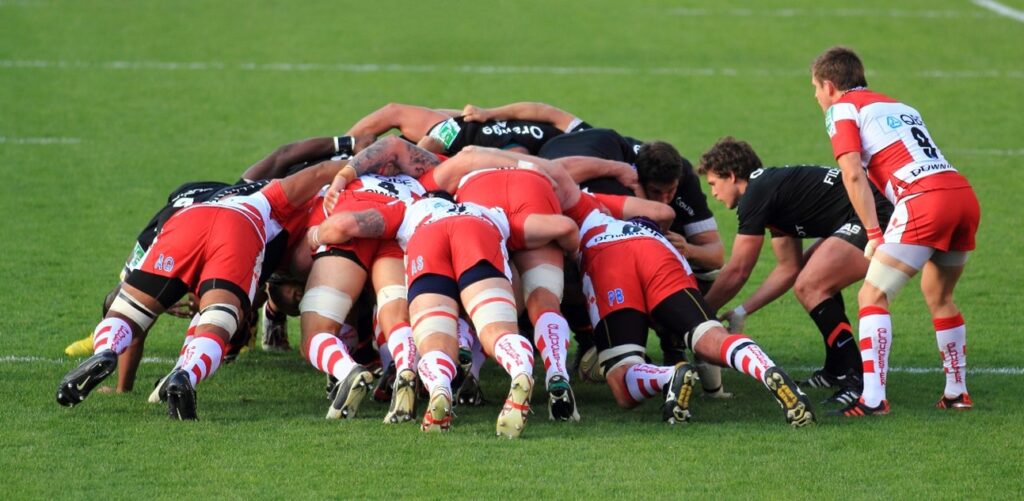
The scrum illustrates the deeper problem. Too often near the posts, spectators watch a tight shove collapse and then hear the whistle. Nobody in the stands knows what happened, sometimes not even the players. The referee awards a penalty, the kicker taps over three points, and the scoreboard changes on the basis of an infringement that was invisible to all but one official. These decisions are fickle, often a matter of interpretation rather than certainty, and yet they carry the same weight as a clear try. Forwards know how to milk these moments – angle in slightly, hold an opponent’s arm, drop a knee – and referees are forced to make a guess. The crowd sees nothing but a heap of bodies; the referee sees a game-changing penalty.
This was never the purpose of the scrum. It was designed to restart play. Turning dominance at one set piece into points distorts rugby. A free kick is enough to reward a stronger pack, but penalties hand referees the power to tilt matches by six or nine points in minutes.
The Richmond Heavies’ reverence for the front row helped push this mindset into law. Their belief that forward power should decide matches carried weight in governance rooms. Beaumont defended penalties as the proper reward for dominance, but in practice it has meant referees are constantly deciding outcomes on technical collapses and invisible infringements.
The result is a sport where coaches, players, and fans walk away talking about officiating rather than rugby. World Cup knockouts, Bledisloe Tests, and league games alike are being shaped by interpretations instead of play.
The fix is simple. Scrums should deliver quick ball, not penalties, and if there is an infringement the sanction should be an automatic free kick. Referees should facilitate, not dominate. Rugby should be decided by tries, tackles, and skill, not by whistle counts. Until then, Beaumont’s legacy and the Heavy mindset will be remembered not for protecting the game, but for allowing it to drift into something else: rugby decided by referees.
What began in the back room of a Belgravia pub lingers on, a reminder that culture set over a pint can shape a sport for decades.
Image credit: By Pierre Selim – Own work, CC BY-SA 3.0, https://commons.wikimedia.org/w/index.php?curid=17336884
John
Posted at 18:02h, 14 OctoberOutstanding summation. Thankyou David for giving a historical perspective to this problem. I am afraid I have all but given up on watching a complete rugby game, a direct consequence of my frustration about a glaring problem that is being ignored by administrators.