


08 Apr From Goodwood to Sydney – Nine Thousand Miles in a Single Seat Biplane

The following is a speech given at the You Wing of the Goodwood Flying Club…
Good Evening and welcome to the Youth Wing of the Goodwood Flying Club.
GO GOODWOOD !!
The BA4 and Goodwood:
The BA4b, which would have been outside but for the weather first arrived at Goodwood in 1968. It had been manufactured in 1966 by Malmo Flygindustri in Sweden and assigned serial no.1 – the prototype.
It had been purchased from its designer Bjorn Andreasson by Peter Phillips (Fl.Lt. P.J.C. Phillips RAF who also collaborated in its design and who was between 1967 and the late 1970’s CFI of this flying school, albeit operating in notably less comfortable surroundings.
In fact for many years the little BA4 lived in its own corrugated iron shed, located
pretty well where the entrance to this building is now.
Peter, who died in 1994, was an outstanding display pilot as some of you more follicly challenged might recall from his displays of the BA4 at air shows in the late 1960’s and 1970’s.
In the Air Force he had flown most of the quick stuff that was then available, Vampires, Sabres, Hunters and was amongst other postings the Central Flying School Vampire display pilot. (When looping keep your finger permanently on the re-light button!) As a civilian he retained his enthusiasm for aerobatics, was an active member of the Tiger Club and did his best to promote UK participation in European Aerobatic
Competition.
Alas, Tiger Moths however skilfully flown were not going to beat Zlins also well flown, but a glance of what might have been was when a Czechoslovak team member offered Peter a go in a Zlin.
I mention Peter at some length because he is fundamental to the story of the BA4 and while much can be researched there are a couple of anecdotes that give one a glimpse of a lighter side of aviation in a different time. When I acquired the BA4 in 1985, it came with a perfunctory and slightly vague set of Pilot’s Notes – not a good thing for Pilot’s Notes and a single 35 mm colour transparency.
(OK, if you don’t know Google it and be pleased you are so young.)
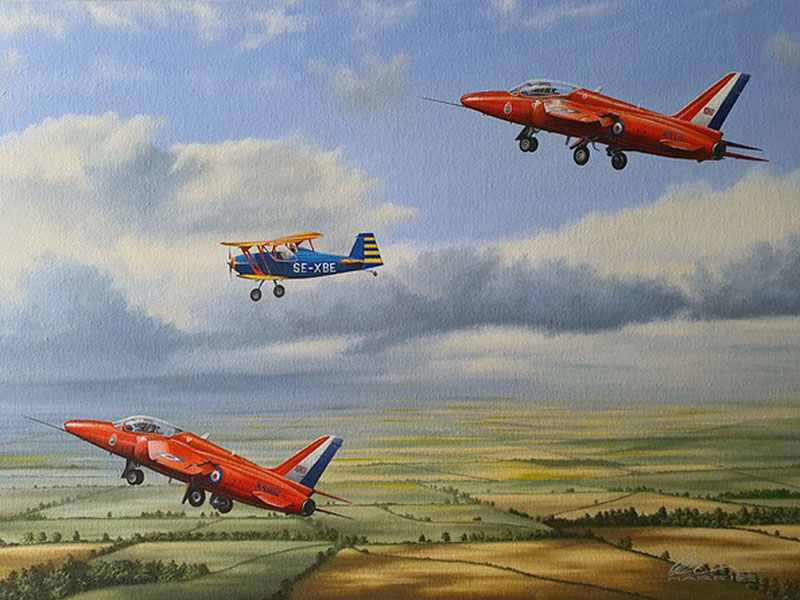
This was a very grainy snap of two Red Arrow Gnats formated on each side of the BA4 and almost certainly taken from another Gnat. Over the years I had tried, unsuccessfully, to obtain satisfactory prints from the transparency. A painting had always been an alternative and when I saw an exhibition of Andrew Harris’s work I asked if he would accept the commission and what you see here, I am sure you will agree, is a splendid, vibrant re-creation.
It was only during the course of Andrew’s work that the story of the photograph began to emerge. The BA4 was still carrying its original Swedish registration, which meant pre 1968, while the Red Arrow livery was specific to 1967, which was one of the seasons when they were led by Ray Hanna. A convenient assumption was that they had formated on Peter, transiting to, or returning from an airshow. I am indebted to Tony Bianchi who explained that Peter and Ray Hanna were good chums, having had contemporaneous careers in the RAF, while after an exchange of correspondence with Ray’s daughter Sarah it became evident, from an extract from his log book, that in fact Ray Hanna had been flying the BA4, with Peter probably the photographer in the the Gnat.
Imagine, if you will:
‘Look old chap have a go in the BA4 it’s a delight – stalls at 61 mph, meanwhile I’ll hop in the back of a Gnat and we’ll go and take a couple of pics.’
Those were the days.
The BA4 came with an RAF issue blue canvas flying helmet with enclosed headphones to which was attached a reworked wire coat hanger serving as a boom for a microphone unit from an Airlite headset, taped to the end.
In those days the BA4 was open cockpit and one can perhaps sympathise with the controllers who complained of the appalling reception and the surprise of one of them on questioning the improved transmission to be advised by Peter that he had turned the engine off! Perhaps it was not exclusively a headset problem.
The Plan
I suppose there are reasons that a nation would wish to celebrate 200 years as a Penal Colony and in 1988 one mooted was an air race from England to Australia. It failed to get traction, although other ventures such as a tall ships race were more successful. In any event I rather suspect convicts would have resented air travel.
Nevertheless the seed once sown germinated and I became increasingly deluded that the BA4 could be made into a suitable vehicle, all it needed was an auxiliary fuel tank, radio aids, charts, clearances and a slightly unbalanced attitude.
At the time I was engaged in the City as a shipbroker, the constraints of which required that the flight be undertaken in the middle of the year while an absence of more than a month would be problematical.
There are compromises to be made when scheduling such a flight and wiser heads ensure that they avoid the SW Monsoons, a luxury which unfortunately was not available to me.
Endurance:
The BA4 has a fuel capacity of 12.4 Imp. galls., basically just over 2 hours flying time plus a reserve, while several of the longer legs required a flight time in excess of 5 hours in still air.
Hence the auxiliary fuel tank which was located beneath the cockpit, between the landing legs and neutral to the centre of gravity. Fuel was routed via a Christen Eagle transfer valve fitted with a wobble pump, which hopefully would ensure access to the fuel in the event of a mechanical pump failure – it did.
In the event of a similar failure when drawing on the main tank Mr. Andreasson had thoughtfully provided an alternative gravity feed routing, activated by a lever in the cockpit.
The auxiliary tank was filled through the cockpit floor, a length of tubing being carried for the purpose.
Navcoms & Navigation
The communications fit comprised a Narco Escort II Nav/Comm radio with a VOR receiver, a Narco ADF and Narco Mode “A” transponder.
A fine ten length win by Richard Dunwoody on ‘Charter Party’ in the 1988 Cheltenham Gold Cup all but funded their purchase.
The radio rack was mounted on the main spar and viewed and controlled between my legs, which despite the unpromising description worked exceptionally well.
However I had to undertake much of the fit myself after two avionic engineers felt they could not manage the required contortions.
Fairly early on in my deliberations I decided to leave the obtaining of clearances to a professional flight planning organisation – in this case Memorykord, who did a first class job.
An unforseen benefit of this arrangement was that by employing such a company one became just another unit in the system and accepted as such by the various controlling authorities, who generally were more respectful of organisations and established practice than dealing with a single individual.
A not especially well known division of the National Air Traffic Services is their AIS division based at Pinner, then led by Barry Davidson who showed genuine interest in the project and was extremely helpful in various aspects of flight planning. I understand that this is now solely an online service which is a great shame.
Charts for the route were ONC (operational navigation charts). These are 1 to 1 million scale topographical charts overlaid with principal radio aids and sector altitudes.
They are confidently and attractively presented, although in remoter areas there are occasional lapses where the cartographers appear to have lost interest but because as a breed they hate blank spaces and as wind blowing cherubs are long out of fashion the embarrassingly white areas carry vague reassurances such as ‘unexplored – heights unknown but not believed to be in excess of 4500’. Borneo was particularly afflicted in this regard.
They were expensive and some difficult to source while such were their size that it was necessary to cut and discard those sections not adjacent to the course line, a wanton but necessary act. These were supplemented by a few airways charts.
The normally eternally reliable Airpath magnetic compass could not be adjusted within limits, neither could its sister placed elsewhere on the panel, while a Hamilton vertically mounted compass on the windscreen likewise had an unacceptable idea of magnetic North.
This problem was partially solved by favouring the compass with the least deviation on the required heading, although this necessitated having three deviation cards taped to the cockpit side.
In the event this proved not to be as troubling as envisaged, as apart from the requirement to avoid the Dead Quarter of Saudi Arabia if you potter off in a South Easterly direction it tends to workout and one of the compasses was acceptable in that quadrant.
The aeroplane now has an ex USAAF fluxgate compass mounted under the turtle deck feeding a vertical card display which works admirably.
Apart from the proliferation of compasses the panel had a centrally mounted Turn & Slip indicator, an Air Speed Indicator (ASI), an Engine Rev. counter and the usual engine gauges (including CHT & EGT).
The ADF display and voltmeter formed part of the radio rack installation.
Health & Safety
Having in the course of general conversation mentioned the important matter of my continuing safety to a Navigator Instructor on Tornados, he called a few days later to determine the BA4’s seat size. Surprised by the question but appreciative of his offer of assistance I nevertheless thought it unlikely that the resources of the RAF could help in this particular regard.
A few days later two parcels arrived, one containing a one man life raft, which also doubled as a seat, the other a nylon string backed jacket, the collar enclosing a life jacket, while numerous pockets contained safety and survival equipment, including flares and heliograph.
The life raft/seat fitted perfectly and included a suede leather top which matched the BA4’s headrest and crash pad.
Purpose designed – but for a GR1 single seat Harrier!
I didn’t dwell on the mechanics as to how it might be deployed, it was just very nice to have.
Barry Hardy-Giddings, who borrowed this equipment from his employers, was one of a number of individuals who collectively facilitated much of the enterprise as well as providing tremendous expressions of personal support.
Off - at last:
After an encouraging spell of early Summer weather, the departure day of Sunday 26th. June, 1988 presented a fairly dismal scene with the airfield under unbroken cloud, which meteorologists with an unusual gift for description refer to as
anti-cyclonic gloom.
My mood was greatly lifted by the unexpected appearance of a number of friends, many of whom had made considerable efforts to get to Goodwood. The 10:00 hours departure time forestalled protracted farewells and after a distressingly long take-off run from 14 and a wallowing low level circuit I disappeared into the overcast at 600’.
It was only after settling down to some extended limited panel instrument flying I began to assess the way forward and made what was probably a poor and unnecessary decision.,
I had fuel to make Cannes and was reasonably confident there would be occasions to let down enroute. On the other hand I had not had an opportunity to calibrate the additional fuel tank – a source of repeated regret – and flight was over increasingly higher ground.
Particularly though I was not enjoying this sudden baptism and decided after over 2 hours instrument flying to take advantage of the NDB at Chateaudon and spent a wet Sunday lunchtime in the spartan dispersal area of the airfield, together with a few other stranded aviateurs priveé.
I mention this at some length because as I sat there it was with a looming sense of failure which only lessened when I realised that I would need a much greater sense of determination and resolution to have a realistic chance of making Australia.
An hour or so later l departed having convinced myself that conditions were better. Judging by my view of Orléan cathedral they were not but did gradually improve going down the Loire and Rhone valleys, first to Avignon and then to a sultry Cannes.
I felt rather cheated as I had hoped to have had a pleasant potter through France as I settled into the venture, unfortunately matters were about to become even more disappointing.
Cannes Meteo had for the day a smart bit of kit, essentially a monochrome low level weather radar which was now showing a necklace of Cu.Nimbs. down the west coast of Corsica, associated with a Trough at right angles to my intended path from Cannes to Brindisi.
Departure from Cannes was straight out over the Mediterranean where I was unable to get above 250’ due to persistent Cu. Nimbs. This became limiting as I approached the coast of Corsica and could find no way through.
Sanity eventually prevailed after I mistook the cliffs in the vicinity of Calvi for another wall of Cu.Nimbs, rapidly putting the helm down and running off to Genoa whose airfield is at sea level and on the coast.
Then in the gathering gloom on to Firenze (Florence). The following morning after a slight tussle with the weather crossed the Apennines to a benign Adriatic and thence a peaceful passage down the east coast of Italy to Bari.
While in Bari I purchased a little notebook for jottings along the route, the following eing a verbatim transcription but for brevity excluding peripheral references.
Bari to Iraklion (29th June)
Calm but dense haze – I/R out of sight of land. Were rerouted direct over Peloponnese.
At 7500’ and +35° (cockpit) both aeroplane and pilot were feeling weary. Radio chose this time to fail in TX again – believe it is overheating like all of us but after threatening Iraklion with radio silence it decided to collaborate, after a cooling off period.
Nose cone which I had yesterday noticed was cracked had split further and had to be removed. The little fellah now looks rather subdued. Doubtful whether it is repairable and will have to decide whether to carry it or not.
Disconnected carb.heat ducting and re-routed heater hose to give ram air cooling to the radio – and me. It will be a relief if it is successful as landing at Cairo without radio could be fraught.
Iraklion to Cairo (30th June)
Calm sea, tailwind, Ac. in patches but foul viz.
Coast to desert no merging of margins quite awesome, rippling, rolling, few outcrops – engulfing; viz. foul but brown instead of white.
Radio reception lousy or Cairo’s/our radio poor. Radio works for longer now with only minor tantrums – like the rest of us obviously likes to stay cool.
Handling – good and expensive $200.
Cairo to Luxor (1st July)
Had to route below airway to E. of Nile so again saw only desert – but a different desert not contoured but gashed with wadis and sculptured by evaporated waterways, mesas.
Luxor to Jeddah (1st July)
35 mins. turnaround in Luxor. Landing fee/handling – $350, protest is useless.
Long slog to the coast – very hot (it had been +45°C in the cockpit at Luxor). Poor aeroplane wallows at FL55, again long slog over the water with constant concern about oil temperature.
The Kingdom
ATC of a very high order, secondary cover throughout.
Jeddah to Riyadh (2nd July)
Initially mountainous outcrops giving way to sand wave areas including barchans.
For all its vastness very rare to see an area without habitation of any sort or evidence of man – tented camps, billeted compounds, irrigated areas, roads, pipelines.
Riyad, +45°C. Handling $400 – Jet Aviation – theft.
Riyadh to Bahrein (2nd July)
Could barely touch the aeroplane it was so hot but eventually after various holds (including binding port brake) got going.
+45°C and 2000’ airfield elevation, aeroplane did very well. Eventually got to 7000’, still in dense sand haze. Desert from Riyadh to Bahrein is mainly wave form free of rock outcrops or evidence of flash flooding.
Bahrein (3rd July)
Pleased to have left most of the desert areas behind – the aeroplane has found it very hard going and so I think have I.
03/July – enforced layday due to inability to advance flight clearances, very frustrating to lose momentum.
Americans chose today to shoot down an Iranian Airbus A300 – circumstances lackcredence, even the US Navy is not that fucking stupid.
Prior to departure spoke to Bahrein Area Controller who was excellent and suggested I work 121.5 MHz. with occasional calls to him.
Seeb (Muscat) (4th July)
Very helpful Sri Lankan engineer helped me complete an oil change and tighten up a few nuts hopefully to control oil seepage.
Splendid terminal building – no paxs.!
Seeb (Muscat) to Karachi (5th July)
5 hrs.15 mins. flight. Fairly tired and already depressed by Karachi. I keep hoping the rest of the sub-continent will not be so bad – then I think of Calcutta.
The Narco Escort radio has an annoying habit of TX CW only, just when you need it to really behave – very disconcerting.
As approached coast of Pakistan thick S/SC so settled on top until PINIAS but thereafter down to 3000’ along the beach and across to ‘Kilo Alpha’ (NDB).
Landed with about 4 gallons.
Karachi to Ahmedabad (6th July)
Very unattractive alluvial glaze of Rand of Kutch – in/out of cloud then between layers.
Buzzed by two air force jets Pakistani or Indian (?) – very exciting.
Customs – Oh! what a bureaucratic legacy we left these people, or perhaps it was an aspect of our administration that by temperament they were well disposed to embrace. Forms all at least in triplicate on flimsy paper, elusive carbons and an ever present fan to frustrate one’s efforts.
4 hours – customs/immigration/fuel/flight plan/comms./met./clearances.
As customs would not turn-to until 0800 hrs. next day (i.e. after cloud activity well established) left that afternoon for Nagpur, although not without misgivings re weather.
In the event fantastic flight between towering Cumulus, picking one’s way through and around, while the land is now of rich foliaged trees covering ranges of hills, cells of them segregated by rich brown rivers.
Nagpur
Arrived just before sunset, radio again decided to perform only intermittently – very embarrassing but theirs looked worse, circa.1930, while the Comms. Room (every tower has one), morse from the most antiquated equipment.
Agent wanted $375 and was dismissed.
More up and down stairs with full kit. Every flight plan needs 3 clearances, every flight plan is filed at the top of the tower.
Hotel – rudimentary, although I apparently had a ‘de luxe’ room in the best hotel in town.
Calcutta (arrived 7th July)
I will have to wait for sense of humour to return but the flight (5hrs15mins) began well and deteriorated ominously as approached Calcutta. Radio again intermittent, ASI reading zero – blocked by rain from recent cloud.
Cb. cloud sitting over the airport but fortunately base 2500’.
Repaired ASI andRadio.
To land in Calcutta – broken radio and ASI, foul weather, very tired, intimidated by paperwork and then to be driven by two joint smoking oiks through the slums (or if they are not I don’t want to see anything worse) represented my real low point of a trip that has had a few.
I also felt very trapped with no clearance for Burma and only Chittagong to go to.
Oberoi Grand Hotel – oasis.
Visa extension !!
Country should sink under the weight of paper but presumably the rubber stamps would float.
Calcutta to Chittagong (9th July)
Foul – departure hindered by bureaucratic demands. In cloud, mist and rain at 700’. Above, broken stratus at 2000’ – eventually arrived Chittagong at 500’ – fortunately airfield on the beach, very depressing.
As ATC had clearance for Rangoon for 9th. July (not 10th.) pushed on again in similar weather. In muck and bullets at 7500’ in vicinity of Sittwe feeling very uneasy as aeroplane still leaks despite taping and am concerned Turn & Slip or radio will get wet.
Finally broke out on top and crossed mountains into Burma amongst most spectacular display of frontal cloud. Light fantastic, country magnificently verdant and inaccessible.
Pagodas marked villages and the orb of the dome of the Grand Pagoda in Rangoon, brilliant in evening.
Had used up all film on ineffectual cloud shots which were taken more out of relief of being above them than for any memorial value.
Interesting ATC – on short finals (no ASI again – rain) was asked to join controller for a whisky – accepted.
Back on schedule – very optimistic for remaining journey.
($800 handling / $356 other fees – very sour note).
Rangoon to Rangoon (10th July)
Took a beating today and although I’ve been in worse bother my reserves must be low as I am still struggling back.
Left in excellent weather (light fair weather cumulus) then 100 nm out wall of Cb’s that I couldn’t get over at 7500’, or under. In broken stratus at 1000’ over sea but with land approaching. No ASI, leaking, turbulent, I quit staggered to 6000’ and went back, to good weather.
3 hours, very demoralising and left me quite chastened but am re-grouping and will try at 0600 hrs. tomorrow hopefully to complete the voyage before the Cb’s wake up.
The engine coughed on three occasions which has not happened before – very salutory, the sound is a lot more disturbing than the more gradual fading from fuel starvation.
On landing/refuelling checked carefully for presence of water – none evident. I hope it doesn’t do it again. 91/96 octane fuel ?
Rangoon to Bangkok to Phuket
0400 hrs. turn-to, to beat the weather !
Departure 0600 local – hassle but not as bad as India.
Low stratus on course, cobalt blue haze – Cb’s – fuck. Skim over the mountains at 6500’ – engine coughing (fuel?) – very nervous.
Over mountains – good route to Bangkok, excellent, thought worst was over.
Bangkok – avoided handling charges – good ATC
Bangkok – down the coast, fabulous, almost confident. Turned SW for Phuket, cumulus upto 7500’. Low level to Phuket 1500’, awful, rain Cb’s.
The west coast with SW monsoon is awful – tomorrow all west coast, a bit of help from the weather would be good.
Bangkok fuel – engine OK.
Another long day.
Phuket to Kuala Lumpur to Singapore (12th July)
Weather pretty bloody – 0830 lmt.
ATC awful – Thai 737 intercepting VOR approach track 2-300’ below after I had been directed into his flight path.
Weather improved away from coast 4/8 cumulus. Malaysia looked delightful until low pressure fuel warning light came on – swap tanks – no change – emergency gravity feed OK.
Actually over an airfield and in contact with Butterworth radar – which excellent. Alerted them of possible deviation to Penang but decided to pump from ferry tank; tiring and difficult, especially when IMC. One armed paperhanger but by hand pumping for an hour and using gravity feed for last 40 mins. Able to get into Kuala
Lumpur.
Maintenance very helpful, stripped mechanical fuel pump – no apparent fault (dirt?), re-assembled, all OK.
Airport facilities excellent, on in gathering gloom to Singapore – excellent vectoring, with 4 airfields in a paddock it needs to be.
Singapore - scheduled as a layday
Spent morning dismantling the aeroplane with maintenance crew from Singapore Flying Club. Left them to it in the afternoon and discussed routing alternatives through Indonesia with an Indonesian aircraft operator based at Singapore, as envisaged routing not practical from fuel scheduling point of view.
The trick seems to be to avoid Djakarta and Bali and routing thereafter largely determined by availability of Avgas.
Decided upon Batam (for customs) then Pontianak to Banjarmasin (Thurs.), Banjarmasin to Hasanuddin and Kupang (Fri.) thence Kupang to Darwin and the
world (Sat.)
Returned to hotel to advise Memorykord and generally take advantage of communication facilities which have been sadly lacking for some days.
Haircut.
Returned to hangar – boxing up.
Singapore to Batam to Pontianak (14th July)
Batam scuppered the Indonesian strategy. Although opened at, and we arrived at, 0900 lmt waited an hour plus for Immigration and Customs and thus unable to make Banjarmasin before their close (1800 lmt) – so Pontianak only.
300 nm water crossing, splendid weather, fairweather cumulus only, light beam wind.
Pontianak has a feel of being somewhere one hasn’t been to before, etched out of the surrounding rural area,it straddles the equator.
Will try for Banjarmasin and thence to Hasanuddin tomorrow – fair old stroll – 380 nm + 320 nm (?)
Pontianak to Banjarmasin (15th July)
Away first light but desolate with low stratus below blanketing all but the tops of the higher hills and higher clouds permitting only a dull light – it could be another planet and after recent engine problems I felt very vulnerable.
The map refers to most of the inland terrain as ‘unexplored’ and is left a chilling white.
Weather perked up a bit and so did I as we approached Banjarmasin.
Banjarmasin to Hasanuddin (Ujung Pandang) (15th July)
Virtually all over water but good flying conditions, requiring to only breach occasional line of cumulus. Sea and sky now have a deep azure richness which I had quite forgotten.
Hasanuddin to Kupang (16th July)
First aircraft away (again) delightful flight, weather has a feeling of stability despite mild SE monsoon wind.
In time for onward leg to Darwin and after quick turnaround was about to depart when assailed by representatives of Customs and Immigration whose superiors required my presence in town.
Ashamed to say became very churlish as prospect of Sat. night in Darwin faded. Equanimity partially restored by the location of the hotel that I am resigned to. It overlooks the bay of Kupang and the Timor sea relieved by numerous local trimaran fishing craft of a type I had seen en route.
Kupang to Kununurra (17th July)
0700 lmt – gorgeous morning, anxious to go.
Singaporean lad delivering a push/pull Cessna to Mt.Isa provided initial company on the crossing although he was direct for Darwin while because of the SE wind I opted for Kununurra.
Had already completed several longer sea crossings this trip and in poorer conditions but there is something unnerving about the Timor Sea and it certainly wasn’t the weather conditions which were splendid but perhaps the culmination of one’s efforts separated by that final stretch of water.
Anyway uneventful …….
+++
There are no further entries in the little notebook that I bought in Italy.
I did not run out of pages but rather that particular discipline failed upon alighting in Terra Australis.
With still over 2000 nm to Sydney and the better part of a continent to traverse one still had to be resolute but at least at the back of one’s mind was the thought that at least here someone might come and look for you.
I arrived at Bankstown, Sydney NSW on 21st. July 1988 – 25 days out from Blighty.
+++
Total flight time 130 hrs. 11 mins.
By way of explanation :-
Narco Escort II VOR/Radio
It was purchased specifically for the trip and favoured partly because of its compact size, dual function capability and modern (for the time) display but principally because you got about three of them for the price of a Bendix.
There was only the one radio and its spasmodic performance caused constant concern. After a particularly extended quiescent period en route to Rangoon I was anxiously fiddling around the back of the box, which I could just reach between my legs, when alarmingly the plug became disconnected.
Unlike most aircraft radio pin connectors this was a flat PC-board type edge connector. I wiped my prints off the strip and gingerly replaced the plug and in appreciation it worked perfectly.
A hundred miles or so later I had figured out what the problem was.
With the engine now generally operating above its normal mid-latitude temperatures oil vapour was finding its way through the firewall to the rear of the radio some inches away and on to the connector strip.
This could now easily be dealt with, while a little tweaking to a rocker box cover when in Singapore provided a permanent solution to the oil vapour issue.
Similarly Narco cannot be blamed for the poor performance of the VOR, which could not identify stations forward of the beam. This took less thought to explain. I had mounted the aerial just forward of the tail wheel and it’s forward reception was blocked by the auxiliary fuel tank!
Fuel problem
Prior to Rangoon the engine had behaved impeccably and after the mechanical fuel pump had been stripped and re-assembled in Kuala Lumpur it returned to this benign state.
It had been necessary to have a barrel of Avgas Shipped into Rangoon in advance and this fuel one suspects was the cause of the problem, although great care was taken in re-fuelling.
Failing ASI
With such a venture there are a number of difficulties one anticipates that prove to be overstated or do not arise, errant compasses and bladder control being prime examples.
Then there are those which are not foreseen such as that a very basic unprotected pitot tube placed on an interplane strut would be susceptible to water ingress in heavy rain and there was a lot of heavy rain.
Specific en route issues:
Egypt – relevant maps and charts repeatedly mandated no deviation from published routings. This meant en route to Cairo a monstrous dogleg over the most stark barren desert I was to encounter, while the route from Cairo to Luxor disappointingly was to the East of the Nile valley and, yes, over desert.
USS Vincennes destruction of Iranian A300 airbus. In the wake of this appalling act the Arabian Gulf was extremely jittery and on passage down the Gulf from Bahrein to Muscat I was passed from one (unnamed) US warship to another using the emergency frequency of 121.5, while intermittently working en route civilian frequencies – only one radio.
It was only after my return to Blighty and telling the yarn to an increasingly attentive military pilot, who afterwards thoughtfully observed that my ground speed of 97 knots and altitude of 7500’ represented a classic helicopter attack profile!
The direct route from Seeb(Muscat) to the Pakistan border (207 nm over water) is partially through Iranian airspace. As much as I disliked a DR navigation exercise in the middle of the Gulf of Oman I flew the extra 70 nm dog-leg and when I subsequently learnt that the Airbus had been shot down in Iranian airspace not far to the North, was pleased that I did.
At the time I viewed the matter a lot more casually than I should have, a mistake I doubt either of the combatants made when considering my presence.
The Kununurra option – the distance between Kupang and Darwin and Kupang and Kununurra are similar – about 445 nm. However the course for Darwin has the SE monsoon wind right on the nose, whereas for Kununurra the headwind component is reduced.
It is generally a benign wind of perhaps 15-17 knots at sea level but at altitude begins to eat into the numbers, while significantly the water crossing to Kununurra is some 150 nm shorter.
In the event the total flight was 05 hrs 08 mins.
It seems the diversion was the right decision, however Kununurra is not a port of entry (as I knew) and I was told by a relaxed Auscop to, ‘…. bugger off back to Darwin’ – 230 nm in the wrong direction.
Wellbeing
In the course of the three week trip I lost over 3 stone (19 kilos) in weight. While an element of this was presumably a result of heightened metabolism brought on by nervousness there were other conspiring factors.
I early on realised it was essential to have the aircraft refuelled and prepared the night before and also to complete such paperwork that it was possible to at that time. This usually resulted in my arriving at an hotel weary, with little appetite and with some hotels outside of normal dining hours, while additionally one intermittently lost an hour through time zone changes.
I also rather compounded matters by trying not to eat, or at least to eat very selectively while transiting the Indian sub-continent to avoid – how shall we put it, discomfort.
It is quite frightening how rapidly one loses the desire to eat – it is very pernicious.
There is no doubt I also, unwisely, got very dehydrated and if I knew a bit more about human physiology I could comment on how this contributed to the problem – I suspect quite a lot. The positive aspect of such neglect was that at no time in flight did I need to de-ballast.
+++
Acknowledgements
The overriding consideration when contemplating such a flight is for a reliable power unit of known provenance. Sadly too many ‘on condition’ Permit aircraft engines do not provide such confidence.
Accordingly the original Rolls Royce 0-200 Continental was shipped to Aerobonner at Shoreham Airport (the Bonner Iron & Steel Works) where Bill supervised its complete rebuild and subsequent dynamometer testing.
Sat behind it for 130 hours it did provide considerable re-assurance.
It is axiomatic that such jaunts cost a bob or two and I was quite over whelmed when the late Murray Judd, mentor and long time sailing chum offered to pay for the fuel.
Notionally this was offset as a business expense, as I carried a letter between the London and Sydney offices (‘airmail’) and the company logo was inscribed on the sides of the aircraft. But that was only part of the story, Murray was
always personally generous.
As this is not an Oscar acceptance speech, perhaps I can just hope that over the years I have thanked all those who, in many different ways contributed to the enterprise, while ascribing special recognition to my beloved Producer, my adored Publisher, my Make-up Artist and of course my aunt in Budleigh Salterton!
Thank you.
Sorry, the comment form is closed at this time.