


17 Feb From Dili to Banda Aceh

A few days ago, I met a recently retired senior officer of the Australian Defence Force to discuss my Remembrance Day project. This new book will examine Australia’s defence posture in view of our deteriorating strategic environment and argue for the implementation of grand strategy to counter the threat. The strategy will be based on the idea Australia’s defence posture is not just tanks and missiles but founded on eight national assets or competencies being geography, population, the economy, infrastructure, education and human capital, governance and diplomacy.
We kicked off with geography with its advantages and disadvantages for the defence of Australia. This inevitably led us to Indonesia and the idea for this essay. As luck would have it, the general had been involved in the Australian relief effort in Aceh following the 2004 Boxing Day earthquake/tsunami. This was a remarkable coincidence since I had been in Jakarta in the years leading up to the formal recognition of East Timor in 2002. It was a low point for Australian Indonesian relations but two years later when Banda Aceh was smashed by an earthquake and overrun by the tsunami that followed Australia’s immediate and unconditional response turned the tide of the relationship.
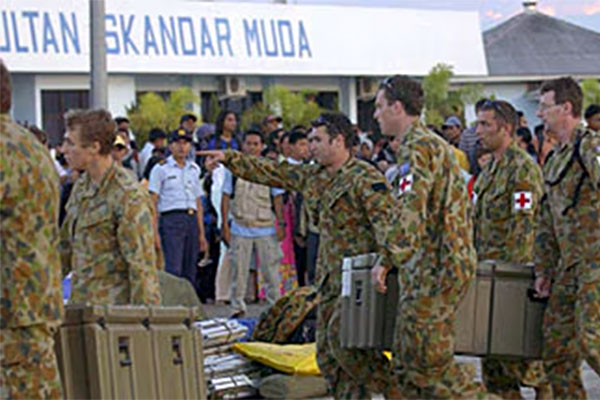
The turn in the conversation took me back twenty-five years to Jakarta 1999. At the time it was impossible to be unaware of events in East Timor or Tim Tim (Timor Timur), as it was called in Indonesia. The crisis was only a short flight away, and much of the informal conversation flowed through the lobby lounge of the Mandarin Oriental Jakarta on Jalan M.H. Thamrin. The bar sat slightly below the lobby floor. Foreign correspondents gathered there most evenings. Some had just returned from Dili; others were preparing to go back. Reports circulated informally, militia violence, evacuations, uncertainty. One did not need official briefings to understand the situation was fraught.
When Australian forces under the command of Peter Cosgrove eventually landed in Dili in September 1999 the operation was conducted with restraint. Militarily it was disciplined and contained but politically it was explosive. Canberra’s engagement with East Timor’s leaders, Xanana Gusmão and José Ramos-Horta, was viewed in Indonesia not as support for a new state but involvement in the loss of a province. Prime Minister John Howard handled the crisis steadily at home, resisting both retreat and triumphalism, yet from Jakarta’s perspective the damage was real. Defence ties contracted. Intelligence cooperation narrowed. The relationship did not collapse, but it certainly cooled. At the time it was difficult to imagine Australian personnel operating again on Indonesian soil in cooperative circumstances.
But fate is a double-edged sword and on 26 December 2004 when the tsunami smashed Aceh things changed. Diplomacy could not have designed a more decisive moment, though no one would have wished for the cause. Indonesia requested assistance. Australia responded quickly under Operation Sumatra Assist. Naval vessels deployed. Engineers and medical teams arrived. By the end of the week Australian defence personnel were once again at work in Indonesia.
The difference lay in consent. In 1999 Australian forces had entered East Timor under international mandate in circumstances Jakarta experienced as coercive. In 2004 they entered Aceh at Indonesia’s invitation to work alongside the TNI. Their task was practical and limited: relief and reconstruction. There were no gestures beyond what the situation required. The operation was professional and measured and that professionalism showed.
Aceh was not a simple environment. The province had a history of internal conflict and a strong Islamic identity distinct even within Indonesia. The sensitivities were real. Yet the cooperation passed without incident. Helicopters moved supplies. Engineers cleared roads. Medical teams treated the injured. In that atmosphere there was no room for ideology.
I have seen something similar in a different setting. Ten years earlier as manager of a pipeline construction project in East Kalimantan and I brought a group of Australian site supervisors and plant operators to work with the local crews. They were construction workers mainly from the Darling Downs with no prior experience of Indonesia and no shared language beyond what could be improvised. The cooperation was immediate. The Australians worked hard, avoided posturing and treated their Indonesian counterparts as equals. The Indonesians responded in kind. The project succeeded not because one side dominated, but because both sides preferred practical results to ceremony. It would be surprising if a similar dynamic had not operated in Aceh.
Aceh did not erase the memory of East Timor. It altered the tone. An intervention seen as intrusive was followed, five years later, by assistance that was requested and delivered without friction. That experience created space for formal rebuilding. In 2006 the two countries signed the Lombok Treaty, restoring a structured framework for security cooperation. Defence dialogue resumed. Exchanges expanded. More recently, the Australia-Indonesia Defence Cooperation Agreement has deepened that architecture. These agreements reflect geography more than sentiment. Indonesia is not an optional partner; it is Australia’s nearest large neighbour. A durable defence posture requires a stable relationship with Jakarta.
The shift did not occur because of a revised interpretation of East Timor, that remains part of the shared memory. What changed was the experience of working together under pressure. The tsunami, an event beyond politics and design, demonstrated cooperation was possible without loss of dignity on either side. That experience mattered more than rhetoric.
When we speak of grand strategy we tend to focus on hardware. Yet credibility, institutional depth and habits of cooperation are also elements of national capability. East Timor strained the relationship. Aceh helped repair it. During that mission many young Australian defense personnel and public servants met and befriended their Indonesian counterparts. These relationships were were revived during subsequent training, commemorative and diplomatic activities naturally paving the way for stronger strategic relations. The present framework rests on both experiences. Australia cannot avoid disagreement with Indonesia; nor should it expect uniformity of view. What it can do is ensure that disagreement does not again harden into estrangement. That, as much as any platform or procurement decision, must be part of our grand strategy.
Luke Harris
Posted at 08:11h, 22 FebruaryAnother excellent and thoughtful post! Hopefully this practical and non-ideological cooperation can be extended far into the future.
Michael Katz
Posted at 09:08h, 22 FebruaryDavid
You are right to focus on Indonesia. It could easily become a great power in our region by virtue of its population and resources. Australia has not done enough to cement ties with one of our closest neighbours. In the world of finance, the links are now almost non-existant. CBA at one stage had a virtual subsidiary there but was unable to manage it profitably. This is more a comment on the lack of expertise in the domestic Australian markets than any comment on the markets in Indonesia.
I look forward to the broad sweepp of your new book project. It should be interesting.