

04 Feb Cecil Rhodes and the Measure of Ambition

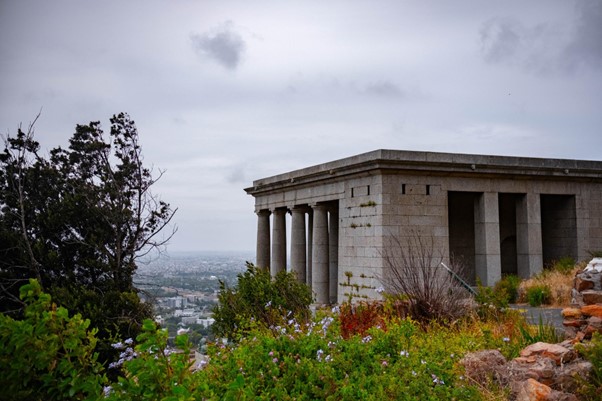
From the terrace of Rhodes Memorial, the eye is drawn northeastward across Cape Town and the rolling interior beyond toward the distant mountain horizons of the African heartland. The view is as vast as Africa – not seaward toward Europe, but inland, toward the continental space that once became Rhodesia. The memorial’s axial alignment reinforces this orientation: Rhodes is positioned not to look backward, but forward into its throbbing heart.
Yet what confronts the visitor today is not only grandeur, but neglect. The monument to a man who thought in continental terms shows visible deterioration and vandalism. In its slow decline, Rhodes Memorial risks becoming something unintended: not merely a monument to Rhodes, but a monument to the smallness of the present – to a culture more comfortable with symbolic rejection than with the hard work of preservation and institutional grit.
Cecil Rhodes was not great because he was flawless. He was great because he refused small horizons. His ambitions extended beyond municipal politics and personal enrichment toward systems, infrastructure, and permanence. He imagined Africa not as a collection of disconnected territories, but as an integrated space linked by rail, commerce, administration, and long-term coordination. In the late nineteenth century, before modern logistics and communications, this was new.
Vestiges of the vision remain embedded in Cape Town’s physical fabric. The upper campus of the University of Cape Town occupies land Rhodes deliberately preserved for public and educational use rather than surrendering to private development. One of Africa’s leading universities stands on that mountainside because Rhodes understood that institutions outlive individuals and that knowledge infrastructure is a civilisational investment.
Likewise, the protected eastern slopes of Table Mountain, including land that later formed the foundation of Kirstenbosch National Botanical Garden, exist because Rhodes chose conservation over subdivision. The gardens, trails, and green corridors that now define this landscape were not accidents of geography. They were the product of deliberate long-term planning.
These are not symbolic legacies. They are functioning civic assets, educating, preserving, and serving, long after the politics of their creation have faded.
Perhaps the most revealing contrast to modern caricatures of Rhodes lies not in monuments or estates, but in the place where he died: a modest seaside cottage in Muizenberg. Not a palace. Not a grand residence. A simple dwelling overlooking False Bay. This detail matters. A pompous man seeks spectacle. A self-absorbed man accumulates luxury. Rhodes did neither. His ambition was outward-facing – directed toward systems, institutions, and territorial projects rather than personal indulgence. He lived simply while thinking expansively. That combination is now rare.
Here the contrast with contemporary culture becomes sharp. Rhodes represented scale, risk, and permanence. Much modern moral discourse, by contrast, is preoccupied with symbolism, procedural fuss, and reputation management. Where he built institutions intended to endure, present fashion often prefers subtraction – removing names, dismantling symbols, and mistaking erasure for achievement.
This is not an argument for uncritical admiration. Rhodes was deeply flawed, and his era carried assumptions different from our own. But he was not small. He did not confuse gesture with accomplishment. He aimed to leave behind systems that would continue functioning after him. Cape Town still lives among those inheritances: universities on preserved land, gardens on protected slopes, public spaces shaped by long vision. What has changed is not the physical legacy. What has narrowed is the appetite for ambition on comparable scale.
And that contraction of horizon, more than any weathered stone or damaged monument, may be the most consequential loss of all.
John Miles
Posted at 14:28h, 05 FebruaryWell said, David. I too had noticed just a few years back the neglect of the Rhodes Memorial, compared with its spotless grandeur that I saw as an eleven-year-old in 1952. The thread of Rhodes influence and reputation through Southern Africa, which was clearly evident to me as a boy has unravelled. The tourist car driver who took us from the V & A waterfront to Groote Schuur Hospital didn’t even know the way to the Memorial!