

20 Oct Apeirogan, A Novel of Great Courage and Greater Excess

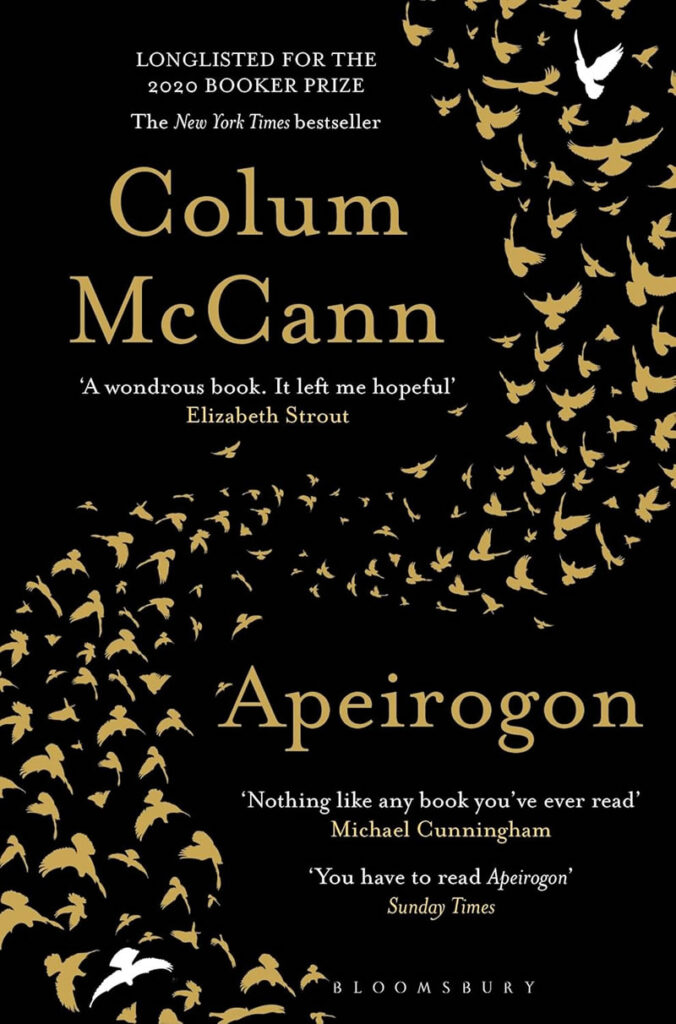
I was given Apeirogon as a present during the recent Australian Festival of Chamber Music. The festival itself was great fun, full of music and good company. Colum McCann’s book is another matter. It’s hard and heartbreaking and finishing it brings a sense of relief as much as admiration.
It is an ambitious and humane work based on a tragedy. Two fathers – Rami Elhanan, an Israeli, and Bassam Aramin, a Palestinian – lose their daughters to violence born of the conflict that surrounds them. Out of their grief grows friendship and a fragile hope. McCann’s empathy for them is unmistakable, and their story radiates dignity. Yet the novel that contains it is also an ordeal. Its lyrical abundance and structural daring, while impressive, often smothers the quiet power of the lives it seeks to honour.
At its core, Apeirogon tells a simple, devastating story. Rami’s daughter Smadar dies in a 1997 suicide bombing; Bassam’s daughter Abir is killed by a rubber bullet ten years later. Instead of turning inward or retaliating, the men find common cause in the Parents Circle, speaking publicly together in the belief that understanding begins with listening. These scenes of shared witness – understated, humane, and often dryly humorous – are the heart of the book. McCann captures the exhaustion of compassion without ever reducing his subjects to symbols. They are men who live with grief and continue to choose life.
But McCann refuses to be satisfied by simplicity. The novel’s title refers to a shape with an infinite number of sides, and his structure mirrors that geometry: 1,001 short, numbered fragments. The nod to One Thousand and One Nights is deliberate. Like Scheherazade, McCann seems to believe that to keep telling stories is to keep death at bay – that narrative itself is an act of survival. Each fragment becomes a bead on a rosary of human experience: bird migration, medieval stonework, the making of a rifle, a line of poetry, a passing thought. Sometimes the fragments glitter with revelation; other times they blur into noise. The technique is meant to reflect the infinite complexity of the conflict, but it also exhausts the reader’s patience. The metaphor of the apeirogon risks becoming literal – infinite sides rendered as endless pages.
Still, there is moral grandeur in what McCann attempts. He brings the Holocaust and the Nakba – the catastrophe of 1948 that scattered the Palestinians – into the same imaginative frame without equating them. Instead, he lets them reverberate through the lives of his two fathers. Both men inherit histories of displacement and terror; both refuse to perpetuate them. In this balancing act, McCann aligns himself with poets such as Mahmoud Darwish, whose work haunts the novel’s sensibility. Darwish wrote that “memory is the exile’s homeland,” and Apeirogon often reads as a prose elaboration of that idea: that to remember truthfully is itself an ethical act.
McCann’s prose glows with lyrical intensity. He can compress entire worlds into a single image – a bird crossing a checkpoint, a daughter’s shoe on a shelf – yet his imagination sometimes overflows its bounds. The digressions accumulate until they threaten to drown the very intimacy they are meant to frame. The reader longs for the stillness of Rami and Bassam’s conversations, for silence instead of symphony. When McCann allows the story to breathe, when he trusts the human moment, the book regains its pulse.
For all its excesses, Apeirogon remains an act of courage – literary, moral, and emotional. McCann’s failures are those of ambition, not indifference. He wants to hold the unholdable: the whole history of pain and endurance in a single narrative vessel. That he cannot quite do so is hardly a surprise; perhaps no one could. But the attempt matters. In Rami and Bassam he has created two men who stand as living arguments against despair.
In the end, Apeirogon is both an elegy and a labyrinth – a novel that gestures toward infinity while anchored in two beating hearts. Like Darwish’s poetry and Scheherazade’s endless nights, it insists that the telling itself is a form of survival. The reader emerges weary but grateful, reminded that the work of empathy is, by nature, unfinished and that even a flawed act of witness can light the darkness.
Angela Timbs
Posted at 18:54h, 20 OctoberEnjoyed this review, thanks David.
Wendy Galloway
Posted at 08:33h, 21 OctoberYour review is an art work and a literary revelation in itself David.
I loved the book and saw it as a beacon of hope and good sense in this troubled part of the world with centuries on conflict. One can only applaud McCann’s ambition and his achievement is remarkable. It is indeed complex but very rewarding. A beautiful interweaving of ideas and language that is seductive and compelling.
I must read it again