
29 Apr A Lost World in Miniature: Stefan Zweig’s Journey into the Past

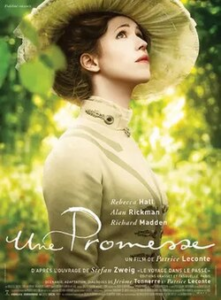 I came to ‘Journey into the Past’ by way of a film. Watching Patrice Leconte’s ‘A Promise’, I was taken by its style, elegance and story. The locations and costumes are beautifully realised, and the performances, particularly Rebecca Hall’s, are finely judged. Yet even as I watched it, I had the sense there was more to it. I should have known. The film was based on a novella by Stefan Zweig.
Years before, while staying with a friend in Bloomsbury, I picked up a copy of ‘The World of Yesterday’ from a coffee table. Noticing my interest, my forever generous host pressed it into my hands: “Take it. You ought to read it.” He was right. It remains one of my most precious books. Since then, Zweig has been a writer I return to because few others render the inner life with such clarity and tenderness.
‘Journey into the Past’ is a superb distillation of that gift. It is, on the surface, a love story, but its real subject is time, and what time does to feeling. Zweig is less interested in events than in the conditions that make feeling possible, and how those influences change, sometimes imperceptibly.
Early in the novella there is a sense of inevitability, an emotional current that seems to carry everything forward. What begins feels as though it must, somehow, find its fulfilment. Zweig renders that certainty without sentimentality; it has the calm assurance of something that believes in its own future.
The novella shows how what once felt certain doesn’t fall apart suddenly, but changes slowly over time. There’s no single dramatic event. Instead, time passes, things shift, people change, and something that once felt clear and solid becomes harder to understand or define.
Towards the end there is a scene that marks a subtle but decisive turning point. Zweig handles it with extraordinary restraint. Nothing is overstated, nothing is spelled out, and yet the reader feels, unmistakably, that something has shifted. It is a moment in which recognition takes precedence over action, where what matters is not what happens, but what is understood, perhaps only half-consciously. It is precisely this refusal to dramatise that gives the scene its force.
From that point, the novella opens into one of Zweig’s central concerns: the relationship between memory and reality. What is preserved inwardly, often with great intensity, does not always survive contact with the present in the same form. This is not because the earlier feeling was false, but because it belonged to a particular arrangement of time, distance, and expectation.
This is where ‘The World of Yesterday’ becomes an illuminating, if subtle, companion. In that memoir, Zweig reflects on a civilisation that seemed stable and enduring yet proved fragile when its underlying conditions changed. He writes, with a kind of astonished hindsight, that what once felt permanent was, in fact, illusory.
Something similar is at work in ‘Journey into the Past’, though on a more intimate scale. The emotional world of the novella possesses a clarity and intensity that feels, at first, entirely secure. Yet as time intervenes, that sense of certainty gives way to something more complex, shaped by absence, by memory, and by the subtle transformations that occur in the intervening years.
This leads to a broader reflection on what might be called the mores of civilisation. The structures and limitations that shape our lives do not simply restrict us; they sometimes create the conditions under which certain forms of intensity and beauty can arise. Yet those same structures impose boundaries. They make some experiences possible, but not necessarily sustainable.
Zweig’s insight is to hold both truths at once. The emotional world he evokes is not diminished by its transience. If anything, it is defined by it. The very qualities that make an experience feel singular may be inseparable from the fact that it cannot be prolonged indefinitely.
To read ‘Journey into the Past’ is therefore to encounter a writer who understands how closely beauty and limitation are intertwined. The novella leaves the reader not with resolution, but with recognition, an awareness of how much of what we value depends on time, and how subtly time alters it. If ‘The World of Yesterday’ mourns the passing of an entire civilisation ‘Journey into the Past’ brings that same sensibility into the most intimate of spaces. In doing so, it achieves something rare: a love story that is not undone by time so much as revealed by it.
Wendy Galloway
Posted at 09:34h, 03 MayA thoughtful review as always David. I will seek out both Stefan Zweig’s book and also the film.
Is it on commercial release or a streaming service?
One of the satisfactions of old age (we do need to keep finding them!) is the pleasure of looking back over decades of experiences and reactions and people who influenced us.
Last night I saw a french film called “Les Musiciens”. It appealed greatly to me as a former string quartet player.
The actors were all fine string players who could act! Mostly actors are chosen for these roles and they clearly have no idea how to play the instruments that they are meant to be masters of. For example Jeremy Irons in
the recent film “The Choral”. Jeremy Irons is a fine actor but he had no conception of what a conductor actually does apart from waving his arms about. Looking forward to some time together when we can talk.
Warm wishes Wendy